Jerusalem
Vision, geography, prophecy, history, and the reasons every believer should have their eyes fixed on this holy city.
Jerusalem Vision
Jerusalem is not merely a city. It is the center of God's redemptive plan for all of Creation — the city where the King will return, where the Eastern Gate will open, and where His feet will stand on the Mount of Olives.
Freedom Road Ministries exists within the larger story of God's unshakeable covenant with Israel. Our eyes are fixed on Jerusalem — not as a geopolitical capital, but as the city of the Great King, the place of Yeshua's return, and the focal point of prophetic fulfillment.
The vision for this ministry was formed over decades — from dreams in college, to a revelation in the Great Dismal Swamp, to gatherings of Aliyah workers — all pointing toward one thing: the urgency of the hour for God's people to return to the land He promised them, before the narrow window closes.
Stand on the Mount of Olives. Face the Eastern Gate. See what the prophets saw. This is the axis of human history — and it is where everything is heading.
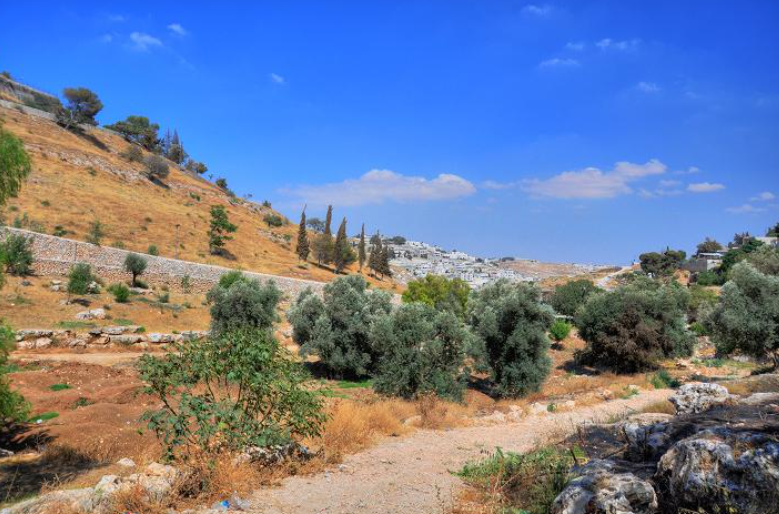
The valley at the southern foothills of Mount Zion, Jerusalem
Why Jerusalem?
- God chose Jerusalem as the place for His name to dwell (1 Kings 8:29)
- Yeshua entered through the Eastern Gate (John 12:12–15)
- Yeshua ascended from the Mount of Olives (Acts 1:9–12)
- He will return to the Mount of Olives (Zechariah 14:4)
- The Eastern Gate is sealed — awaiting His return (Ezekiel 44:2–3)
- Psalm 122:6 commands us to pray for her peace
Jerusalem in Numbers
Jerusalem is mentioned over 800 times in the Bible. Zion — another name for the city — appears 152 times. No other city in the world receives this concentration of prophetic attention. There is no accident in this. Yah has staked His eternal reputation on this city and its ultimate redemption.
Mount of Olives & Eastern Gate
The Geographic Significance
Stand on the Mount of Olives facing west, and you are looking directly at the Eastern Gate of Jerusalem — also called the Golden Gate, the Beautiful Gate, or the Gate of Mercy. This is no accident of geography. These two landmarks form one of the most theologically significant sight lines in all of human history.
The Mount of Olives
The Mount of Olives rises approximately 200 feet above the Temple Mount, lying directly to the east of Jerusalem across the Kidron Valley. It was from this mountain that Yeshua ascended into heaven (Acts 1:9–12), and it is to this same mountain that He will return (Zechariah 14:4). The Jewish cemetery on the Mount of Olives — the oldest in the world — reflects the ancient belief that the resurrection of the dead will begin there.
The Eastern Gate (Golden Gate)
The Eastern Gate is the only gate that faces directly east — toward the Mount of Olives. It is the gate through which Yeshua entered Jerusalem in His triumphal entry (John 12). The Ottoman Sultan Suleiman the Magnificent sealed the gate in 1541 — some historians say specifically to prevent the Messiah from entering through it. The gate has remained sealed to this day, exactly as Ezekiel 44:1–3 prophesied: God Himself closed it because He entered through it, and it is reserved for the Prince.
Preferred: licensed personal photo or Creative Commons.
Suggested file name: assets/eastern-gate.jpg
Suggested file name: assets/mount-of-olives.jpg
The Prophetic Connection
These three scriptures form an unbroken prophetic line connecting the Eastern Gate and the Mount of Olives to the return of Yeshua:
The View from the Mount of Olives
To stand on the Mount of Olives looking west is to stand where the disciples stood as Yeshua ascended. The Eastern Gate is directly in the line of sight. The Kidron Valley lies between the two. The Temple Mount is just beyond the gate.
The sealed gate. The empty tomb. The hill where He will return. All within one view. This is why Clark says: "Fix your gaze on Jerusalem, not Washington."
Key Scriptures Anchoring This Ministry
These are the scriptures that form the theological foundation of Freedom Road Ministries — anchoring our understanding of Jerusalem, Aliyah, and the role of Gentile believers.
Jerusalem & Return of the King
Aliyah & Gentile Calling
Jerusalem & the Crusades
The Crusades represent one of the most complex — and darkest — chapters in the history of the relationship between Christianity and the Jewish people. Understanding this history is essential for any Christian who claims to love Israel and support her people.
Historical Overview
The Crusades were a series of religious wars initiated primarily by the Latin Church (Catholic papacy) between 1095 and 1291, with the stated goal of reclaiming Jerusalem and the Holy Land from Muslim rule. Eight major Crusades are generally recognized, along with numerous smaller expeditions.
What is often not taught in churches is the devastating impact the Crusades had on Jewish communities across Europe and in Israel itself. As Crusader armies marched toward Jerusalem, they frequently attacked and massacred Jewish communities along their route — in the Rhineland, in France, and in the Land of Israel itself.
A Sober Historical Note
In 1099, when Crusaders captured Jerusalem, they reportedly massacred most of Jerusalem's Muslim and Jewish inhabitants. Jewish residents who had sought refuge in the main synagogue perished when it was set on fire. These events cannot be ignored or minimized by anyone who claims to love the Jewish people in the name of Yeshua haMashiach.
Understanding this history deepens our repentance, our intercession for Israel, and our resolve to stand with the Jewish people in our own generation — not as conquerors or crusaders, but as servants called to carry them home.
The Eight Major Crusades
| Crusade | Years | Key Events |
|---|---|---|
| First Crusade | 1096–1099 | Rhineland massacres of Jews; capture of Jerusalem (1099); massacre of inhabitants |
| Second Crusade | 1147–1149 | Renewed attacks on Jewish communities; failed military campaign |
| Third Crusade | 1189–1192 | Led by Richard I (Lionheart); massacres at York, England; failed to retake Jerusalem |
| Fourth Crusade | 1202–1204 | Never reached Jerusalem; ended in sack of Constantinople |
| Children's Crusade | 1212 | Thousands of children; many died or were sold into slavery |
| Fifth Crusade | 1217–1221 | Targeted Egypt; failed |
| Sixth Crusade | 1228–1229 | Frederick II negotiated (not fought) brief control of Jerusalem |
| Seventh & Eighth Crusades | 1248–1272 | Led by Louis IX of France; both failures; end of major Crusading era |
The decline of nations that persecuted the Jewish people — from Rome to Spain to Nazi Germany — stands as sobering testimony to the unchanging word of Genesis 12:3. We do not stand with Israel for political reasons. We stand with Israel because God's covenant is eternal, and we fear the Lord.
Historical Context
The Crusades were launched in an era when religious identity and political power were tightly fused. Pope Urban II called the First Crusade in 1095 at the Council of Clermont, promising spiritual indulgences to those who fought.
Jerusalem had been under Muslim rule since 637 AD (with brief Byzantine interruptions). By the time the Crusades ended in 1291, the city had changed hands multiple times — but the Jewish community suffered consistently under virtually every regime.
Learning from This History
For a Gentile believer supporting Aliyah today, the Crusade history is a sobering warning: religious zeal without the love of God and obedience to His Word is dangerous. We are not crusaders. We are servants.
Our goal is not to conquer Jerusalem. Our goal is to carry her people home in love — as Isaiah 49:22 describes — until the King returns and takes His rightful place.
1800s Zion Prophecy — J. C. Ryle (1879)
AMAZING — From 1879!
J. C. Ryle (1816–1900), the first Anglican Bishop of Liverpool, published this prophetic message in 1879 — 70 years before the nation of Israel was reborn in 1948. His accuracy is remarkable.
Biblical Prophecy and the Regathering of Israel
From the sermon compiled in Coming Events and Present Duties, published 1879. Excerpted and shared with attribution.
Ryle taught that the numerous prophetic texts that mention the gathering and restoration of the Jews in the latter days — including Isaiah 11:11–12, Ezekiel 37:21, Hosea 3:4–5, and Amos 9:14–15 — "all point to a time which is yet future. They all predict the final gathering of the Jewish nation from the four quarters of the globe and their restoration to their own land."
His understanding of the prophecies was obviously accurate — the nation of Israel was reborn about 70 years after he shared the message, and the Jews have indeed regathered in an unconverted state, exactly as he predicted from Scripture.
Throughout the message, Ryle provides excellent teaching regarding how the church should relate to the Jewish people, and how we should approach Scripture and prophecy with faith — not rationalization, not spiritualization of plain promises, but simple, steadfast belief in what God has said.
Ryle's Key Prophetic Scriptures
- Isaiah 11:11–12 God will recover His people a second time from all nations
- Ezekiel 37:21 "I will take the Israelites out of the nations… and bring them back into their own land"
- Hosea 3:4–5 Israel shall return and seek the Lord and David their King
- Amos 9:14–15 "I will plant them on their land, and they shall never again be uprooted"
- Zephaniah 3:14–20 The Lord will restore the fortunes of Israel
- Jeremiah 31:10 "He that scattered Israel will gather him"
J. C. Ryle (1816–1900)
John Charles Ryle was an English evangelical Anglican bishop — the first Bishop of Liverpool — known for his clear, direct exposition of Scripture and his willingness to take prophetic passages at their literal, plain meaning.
Writing in 1879 — nearly 70 years before Israel's rebirth in 1948 — Ryle insisted the Jewish people would literally return to their literal land. He was right in every detail.
The 70-Year Gap
Ryle published this message in 1879.
The State of Israel was declared on May 14, 1948.
That is exactly 69 years later — within Ryle's own century.
The word of the Lord stands. Every promise will be fulfilled. Every prophecy will find its completion in His perfect time.
Eight Reasons Christians Should Support Israel
These are not political positions — they are scriptural obligations rooted in God's eternal covenant with Abraham, His love for His chosen people, and the calling He has given to Gentile believers. These eight obligations are drawn directly from Scripture.
Comfort God's People
The Jewish people carry a burden of history that most Gentile believers cannot imagine. Our first calling is to speak comfort — not condemnation, not theology lectures, but comfort, in word and in deed.
Pray for & Watch Over Jerusalem
Prayer for Jerusalem is a direct command — and a promise. "They shall prosper who love you." This is not optional for the obedient believer.
Carry — Support Aliyah
There are 64 Old Testament scriptures prophesying Aliyah — the return of the Jewish people to Israel. Gentile believers are explicitly identified as carriers and supporters of this return. This is one of the central callings of Freedom Road Ministries.
Show Mercy
Gentiles received mercy through Israel's disobedience. How can we not show mercy in return? Our mercy toward Israel is part of God's own redemptive strategy.
Contribute — Materially & Practically
We have received incalculably from Israel — the Scriptures, the Messiah, salvation itself. Our material contribution to Aliyah is not charity. It is debt repayment and covenantal faithfulness.
Provoke to Jealousy
Paul says that one purpose of Gentile salvation is to provoke Jewish people to jealousy — to see something in us that makes them long for the God of Israel. The way we love, serve, and bless the Jewish people can be a testimony.
Proclaim
We are called to proclaim — to announce God's faithfulness to Israel, to declare His prophetic Word, to lift up the good news that Yeshua is coming back and that Israel's restoration is near. This is the work of Freedom Road Ministries.
Bless and Do NOT Curse
This is the foundation of all Christian relationships with the Jewish people. God's word here is unequivocal: blessing flows to those who bless Israel; cursing follows those who curse her. History — from the fall of Rome, to the Spanish Inquisition, to Nazi Germany — confirms this principle without exception. We do not stand with Israel to be blessed. We stand with Israel because we fear God.
Eight Prerogatives
These are the divine prerogatives — the rights and authority God has given — regarding His purposes for Israel, the land, and the nations. They are not negotiable, not transferable, and not subject to revision by any human authority, government, or theological system.
1God's Unconditional Covenant with Abraham
The Abrahamic covenant (Genesis 12, 15, 17) is unconditional — it does not depend on Israel's obedience but on God's own oath. No theological system, no political decision, and no human failing can void this covenant. God has sworn by Himself (Hebrews 6:13–17).
2The Land Belongs to Israel — By Divine Grant
The Land of Canaan — the Land of Israel — was given by God to Abraham and his descendants as an everlasting possession (Genesis 17:8). This is not a political claim. It is a theological statement about divine ownership. God is the ultimate landlord; Israel is the tenant He appointed.
3God's Right to Scatter and Regather
God Himself declared that He would scatter Israel among the nations for disobedience (Deuteronomy 28) — and that He Himself would regather them in the last days (Deuteronomy 30; Isaiah 11:11–12). Both halves of this promise are His prerogative alone. The regathering is underway, and no human power can stop it.
4Jerusalem as God's Chosen City
"The Lord has chosen Zion; He has desired it for His dwelling place" (Psalm 132:13). Jerusalem is not merely a historical or cultural capital. It is God's chosen city — the place where His name dwells, the city of the Great King (Psalm 48:2). No international body, UN resolution, or political treaty can override this divine designation.
5The Jewish People as God's Chosen and Beloved
"You are a holy people to the Lord your God; the Lord your God has chosen you to be a people for Himself" (Deuteronomy 7:6). This election is not based on merit but on God's sovereign love. "As regards election, they are beloved for the sake of their forefathers. For the gifts and the calling of God are irrevocable" (Romans 11:28–29).
6God's Exclusive Right to Judge Israel
While God disciplines Israel (Jeremiah 30:11), He does not permit the nations to exceed their mandate in doing so. Nations that have gone beyond what God permitted in their treatment of Israel have faced divine judgment (Zechariah 1:15). This is God's prerogative alone — not ours to execute, only to recognize.
7The Messianic Return to Jerusalem
Yeshua will return to Jerusalem — specifically to the Mount of Olives (Zechariah 14:4), through the Eastern Gate, and to rule from Zion (Isaiah 2:3). This is not metaphor. This is divine prerogative — God's own plan for the culmination of history, centered on the city and the people He chose from the beginning.
8The Ingathering of All Israel in the End
"And so all Israel will be saved" (Romans 11:26). The full ingathering of the Jewish people — physical and spiritual — is God's sovereign plan for the end of the age. Our role as Gentile believers is to participate in this plan through prayer, support, and active love — carrying Israel home until the King comes to finish what only He can finish.